
Three Poems
Michael R. Burch
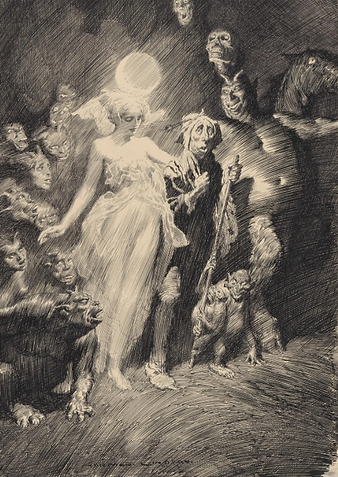
(the Fall and Resurrection of Icarus with the assistance of Tom o’ Bedlam)
Athena takes me
sometimes by the hand
and we go levitating
through strange Dreamlands
where Apollo sleeps
in his dark forgetting
and Passion seems
like a wise bloodletting
so that all I remember,
upon awaking,
is: to Love sometimes
is like forsaking
one’s Being—to glide
heroically beyond thought,
forsaking the here
for the There and the Not.
*
O, finally to Burn,
gravity beyond escaping!
To plummet is Bliss
when the blisters breaking
rain down red scabs
on the earth’s mudpuddle ...
Feathers and wax
and the watchers huddle ...
Flocculent sheep,
O, and innocent lambs!,
I will rock me to sleep
on the waves’ iambs.
*
To sleep’s sweet relief
from Love’s exhausting Dream,
for the Night has Wings
pallid as Moonbeams—
they will flit me to Life
like a huge-eyed Phoenix
fluttering off
to quarry the Sphinx.
*
Riddlemethis,
riddlemethat,
Rynosseross,
throw out the Welcome Mat.
Quixotic, I seek Love
amid the tarnished
rusted-out steel
when to live is varnish.
To Dream—that’s the thing!
Aye, that Genie I’ll rub,
soak by the candle,
aflame in the tub.
*
Riddlemethis,
riddlemethat,
Rynosseross,
throw out the Welcome Mat.
Somewhither, somewhither
aglitter and strange,
we must moult off all knowledge
or perish caged.
*
I am reconciled to Life
in crypts beyond thought—
where I’ll Live the Elsewhere
and Dream of the Naught.
Methinks it no journey;
to tarry’s a waste,
so fatten the oxen;
make a nice baste.
I am coming, Fool Tom,
we have Somewhere to Go,
though we injure noone,
ourselves wildaglow.
- - -
Originally published in The Ekphrastic Review
- - -
Mike’s notes: “This odd poem invokes and merges with the anonymous medieval poem ‘Tom o’ Bedlam’s Song” and W. H. Auden’s modernist poem ‘Musée des Beaux Arts,’ which in turn refers to Pieter Breughel’s painting ‘The Fall of Icarus.’ In the first stanza Icarus levitates with the help of Athena, the Goddess of Wisdom, through ‘strange dreamlands’ while Apollo, the Sun God, lies sleeping. In the second stanza, Apollo predictably wakes up and Icarus plummets to earth, or back to mundane reality, as in Breughel’s painting and Auden’s poem. In the third stanza the grounded Icarus can still fly, but only in flights of imagination through dreams of love. In the fourth and fifth stanzas Icarus joins Tom Rynosseross of the Bedlam poem in embracing madness by deserting ‘knowledge’ and its cages (ivory towers, etc.). In the final stanza Icarus agrees with Tom that it is ‘no journey’ to wherever they’re going together and also agrees with Tom that they will injure no one along the way, no matter how intensely they glow and radiate. The poem can be taken as a metaphor for the death and rebirth of Poetry, and perhaps also as a prophecy that Poetry will rise, radiate and reattain its former glory...“
- - -
Michael R. Burch is one of the world’s most-published poets, with over 11,500 publications, including poems that have gone viral. This does not include self-published writings; if self-published writings were included, Mike’s total publications would be well over 20,000. Mike has also had 74 poems set to music by composers, from swamp blues to classical. He is also a longtime editor, publisher, and translator of Jewish Holocaust poetry and poems about the Trail of Tears, Hiroshima, Ukraine, the Nakba, and school shootings. Mike’s full biography may be read here.
- - -
Hop to…
David E. | David S. | Don | Ethan | Gail | Janet | Janice | John | Mark | Melissa | Paul | Steven | Susan | Word-Bird
.png)